


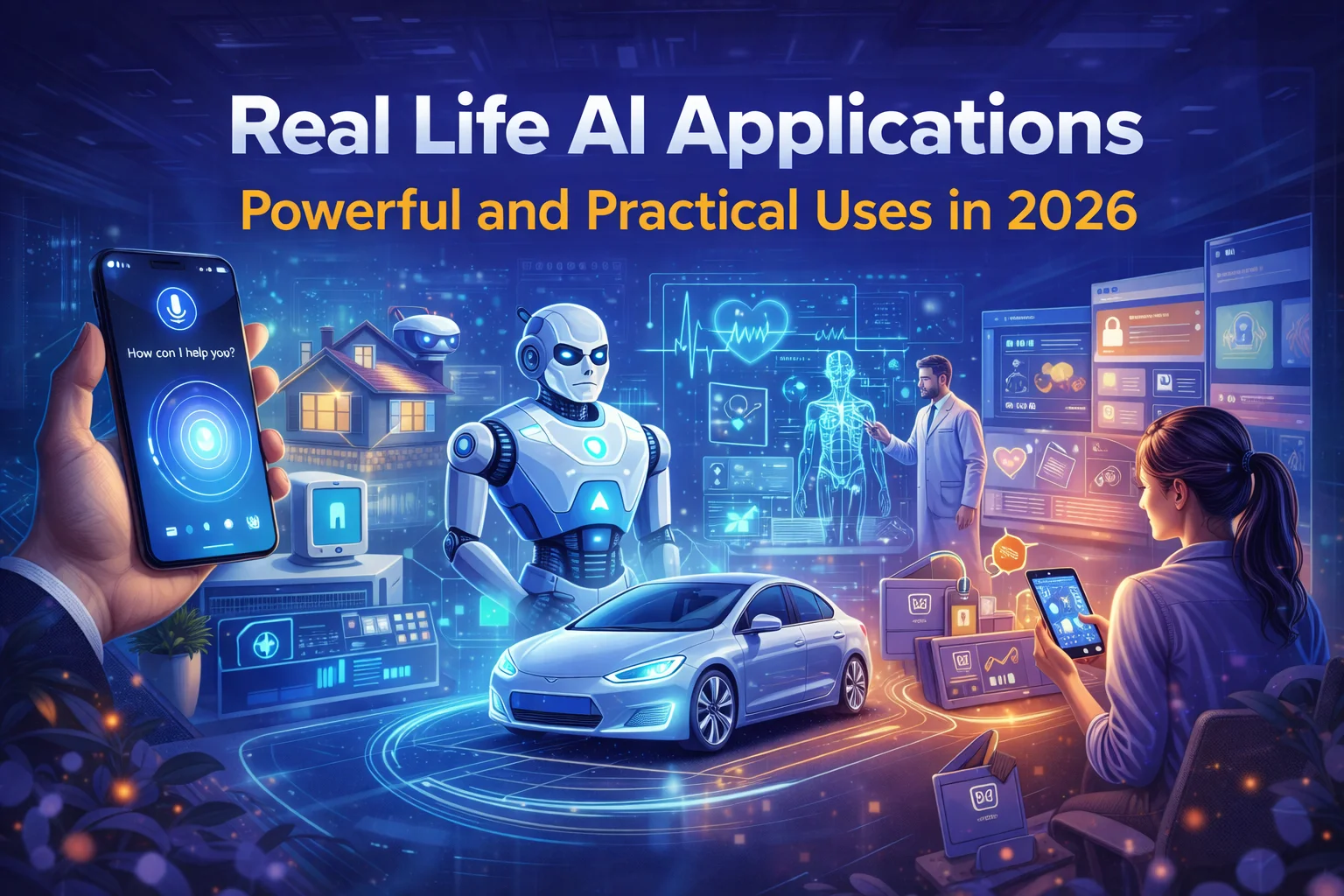
Artificial intelligence is no longer limited to research laboratories, technology companies, or futuristic concepts. Everyday AI applications are now built into many of the digital products and services people use regularly.
From navigation and translation to shopping recommendations, smart homes, learning tools, and digital assistants, AI can quietly perform tasks that help people save time and process information more efficiently.
According to IBM, artificial intelligence enables computers and machines to perform capabilities such as learning, language understanding, problem-solving, decision-making, and generating content. Read IBM’s overview of artificial intelligence.
For more practical AI guides and technology insights, visit Living With AI.
What Are Everyday AI Applications?
Everyday AI applications are artificial intelligence features or systems that help people perform common tasks in their daily routines.
You may interact with AI when you:
- Use a navigation app.
- Unlock a smartphone with facial recognition.
- Translate a message.
- Receive a product recommendation.
- Use voice recognition.
- Ask an AI assistant a question.
- Organize digital information.
- Learn a new skill.
- Compare products online.
- Plan a trip.
Many of these applications work quietly in the background. Users may benefit from AI without even realizing that artificial intelligence is involved.
Navigation is one of the most practical everyday AI applications.
Modern navigation systems can process information about traffic, road conditions, travel patterns, and estimated speeds to recommend routes.
Instead of simply showing a map, these systems can help users estimate travel time and identify alternative routes when conditions change.
This can be particularly useful for commuters, delivery drivers, travelers, and people who regularly drive in busy areas.
However, navigation predictions are not guaranteed to be accurate. Accidents, road closures, construction, weather, and sudden traffic changes can affect the suggested route.
2. AI Translation and Communication
Translation tools are another important example of everyday AI applications.
AI-powered language systems can translate text and speech between different languages. They can also help users rewrite messages, understand unfamiliar expressions, summarize text, and communicate more effectively.
This can help travelers, students, businesses, remote workers, and families communicate across language barriers.
However, automated translation should not automatically replace professional human translation. Legal documents, medical information, contracts, immigration documents, and other important material may require qualified translators.
3. Personalized Recommendations
Recommendation systems are among the AI technologies people encounter most frequently.
Streaming platforms can recommend movies and music. Online stores can suggest products. News platforms can recommend articles, while social networks can personalize the content displayed to users.
These are practical everyday AI applications because they help people navigate enormous amounts of digital content.
Recommendations can save time, but users should remember that algorithms select what they see based on available data and programmed systems.
A recommendation does not necessarily mean that something is the best option or the only option available.
4. AI for Accessibility
Artificial intelligence can also make digital technology easier to access.
Speech recognition, automatic captions, image descriptions, text assistance, and voice-based interfaces can help people interact with computers and mobile devices in different ways.
These everyday AI applications can be particularly valuable for people with disabilities.
AI-powered accessibility features can help users communicate, understand digital content, navigate interfaces, and complete tasks with greater independence.
Responsible AI development should consider accessibility from the beginning rather than treating it as an optional feature.
5. Smart Homes and Connected Devices
Smart home technology provides another practical example.
AI and automation can help connected devices manage lighting, temperature settings, reminders, security notifications, and other household routines.
For example, smart systems can detect patterns in usage and automate certain activities according to user preferences.
These everyday AI applications can make household routines more convenient, but connected devices also introduce privacy and security considerations.
Users should:
- Use strong passwords.
- Keep software updated.
- Secure their home network.
- Review device permissions.
- Disable unnecessary features.
- Avoid sharing sensitive information unnecessarily.
6. AI for Personal Organization
AI assistants can help users organize information and complete repetitive tasks.
Some common uses include:
- Summarizing documents.
- Creating checklists.
- Organizing notes.
- Drafting messages.
- Brainstorming ideas.
- Structuring information.
- Creating simple schedules.
- Explaining complicated subjects.
For professionals and students, these everyday AI applications can reduce the amount of time spent on routine information processing.
However, users should review AI-generated content before using it. AI systems can make mistakes or misunderstand context.
You can explore more practical artificial intelligence topics and guides on Living With AI.
7. AI for Learning and Education
Education is another area where everyday AI applications are becoming increasingly useful.
Students and lifelong learners can use AI tools to practice languages, understand mathematical concepts, learn programming, improve writing, generate practice questions, and explore unfamiliar subjects.
AI can provide explanations at different levels of difficulty and allow learners to ask follow-up questions.
UNESCO’s AI competency framework emphasizes the importance of helping students develop AI knowledge, ethical awareness, and critical judgment. Read UNESCO’s AI Competency Framework for Students.
AI should therefore be used as a learning assistant rather than a replacement for independent thinking.
Students should verify important information and follow the AI policies of their educational institutions.
8. AI for Shopping Research
Online shopping has also benefited from everyday AI applications.
AI systems can help users compare product features, understand technical specifications, summarize product information, and create shortlists.
For example, a shopper researching a laptop could use AI to compare processors, RAM, storage, display specifications, battery life, and other features.
However, AI-generated recommendations should not be the only source used before making a purchase.
Consumers should also check:
- Independent reviews.
- Current prices.
- Warranty terms.
- Return policies.
- Seller reputation.
- Manufacturer specifications.
- Product safety information.
AI can speed up research, but the final purchasing decision should remain with the consumer.
9. AI for Travel Planning
Travel planning is another growing area for everyday AI applications.
AI tools can help travelers brainstorm destinations, create itinerary ideas, organize activities, and adapt plans according to interests.
A traveler might ask an AI system to create a three-day itinerary focused on museums, food, nature, historical attractions, or family activities.
However, travel information can change quickly.
Before relying on an AI-generated travel plan, verify:
- Transportation schedules.
- Attraction opening hours.
- Ticket prices.
- Entry requirements.
- Visa information.
- Weather conditions.
- Local regulations.
- Hotel availability.
AI is useful for planning ideas, but current information should always be checked with official sources.
10. AI for Managing Digital Information
People now have access to huge amounts of digital information.
AI can help summarize documents, identify important sections, classify information, extract key points, and organize text.
These everyday AI applications can be useful for students, researchers, employees, business owners, and anyone who regularly works with large amounts of information.
For example, an AI tool can summarize a long report and identify the main topics that require further attention.
However, summaries should not replace the original source when the information is important. Users should check the original document before making significant decisions.
Benefits of Everyday AI Applications
The biggest benefit of everyday AI applications is often convenience.
AI can reduce repetitive work and help users process information faster.
Common benefits include:
- Saving time.
- Reducing repetitive tasks.
- Improving accessibility.
- Supporting communication.
- Helping with research.
- Making learning more interactive.
- Personalizing digital experiences.
- Organizing information.
- Supporting travel planning.
- Helping users compare options.
The goal should not be to automate every decision. Instead, AI can handle certain tasks while people remain responsible for important judgments.
How to Use Everyday AI Applications Safely
AI can be useful, but convenience should not come at the expense of privacy or security.
Before entering information into an AI system, consider whether the information is necessary.
Avoid sharing sensitive information such as:
- Passwords.
- Banking details.
- Private identification documents.
- Confidential business information.
- Sensitive personal records.
Users should also verify important AI-generated information instead of assuming that every response is accurate.
UNESCO promotes a human-centered approach to AI and highlights issues such as inclusion, equity, critical thinking, ethics, and human agency. Learn more about UNESCO’s work on AI and education.
Limitations of Everyday AI Applications
Artificial intelligence can be powerful, but it is not perfect.
AI systems may:
- Produce incorrect information.
- Misunderstand a question.
- Provide outdated information.
- Generate misleading content.
- Reflect limitations in their training data.
- Give confident answers without sufficient context.
For this reason, AI should be treated as an assistant rather than an unquestionable authority.
For medical, legal, financial, safety, or other high-stakes decisions, users should consult appropriate professional or official sources.
AI as a Tool, Not a Replacement for People
The most useful everyday AI applications are often simple.
AI may help someone find a faster route, translate a message, organize notes, learn a difficult topic, compare products, or create a travel plan.
These tasks may seem small individually, but together they can make digital life easier.
The important skill is not simply knowing how to use AI. It is knowing when to use AI, when to verify its output, and when human expertise is necessary.
As artificial intelligence continues to develop, people who understand both its benefits and limitations will be better prepared to use it responsibly.
Frequently Asked Questions About Everyday AI Applications
What are everyday AI applications?
Everyday AI applications are artificial intelligence features and tools used for common activities such as navigation, translation, recommendations, accessibility, learning, shopping, travel planning, and digital organization.
Where do people encounter AI every day?
People can encounter AI in smartphones, navigation apps, search engines, streaming services, online stores, social media, smart home devices, translation tools, digital assistants, and productivity applications.
Are everyday AI applications useful?
Yes. AI can save time, automate repetitive activities, organize information, provide recommendations, support learning, and make some digital services easier to use.
Can AI make mistakes?
Yes. AI systems can produce inaccurate or incomplete information. Important information should always be verified against reliable sources.
How should students use AI?
Students can use AI for practice, explanations, brainstorming, research support, and study preparation. They should maintain critical thinking, verify information, and follow their school’s AI policies.
Is AI replacing human judgment?
AI can assist with many tasks, but human judgment remains important. High-stakes decisions often require expertise, context, responsibility, and professional knowledge.
Final Thoughts
Everyday AI applications are becoming part of ordinary digital life.
From navigation and communication to education, shopping, smart homes, travel, accessibility, and information management, artificial intelligence can help people complete many tasks more efficiently.
The best approach is neither to depend completely on AI nor to avoid it.
Instead, use AI as a tool, verify important information, protect private data, and keep human judgment at the center of important decisions.
For more practical AI information, guides, and technology insights, visit Living With AI.