

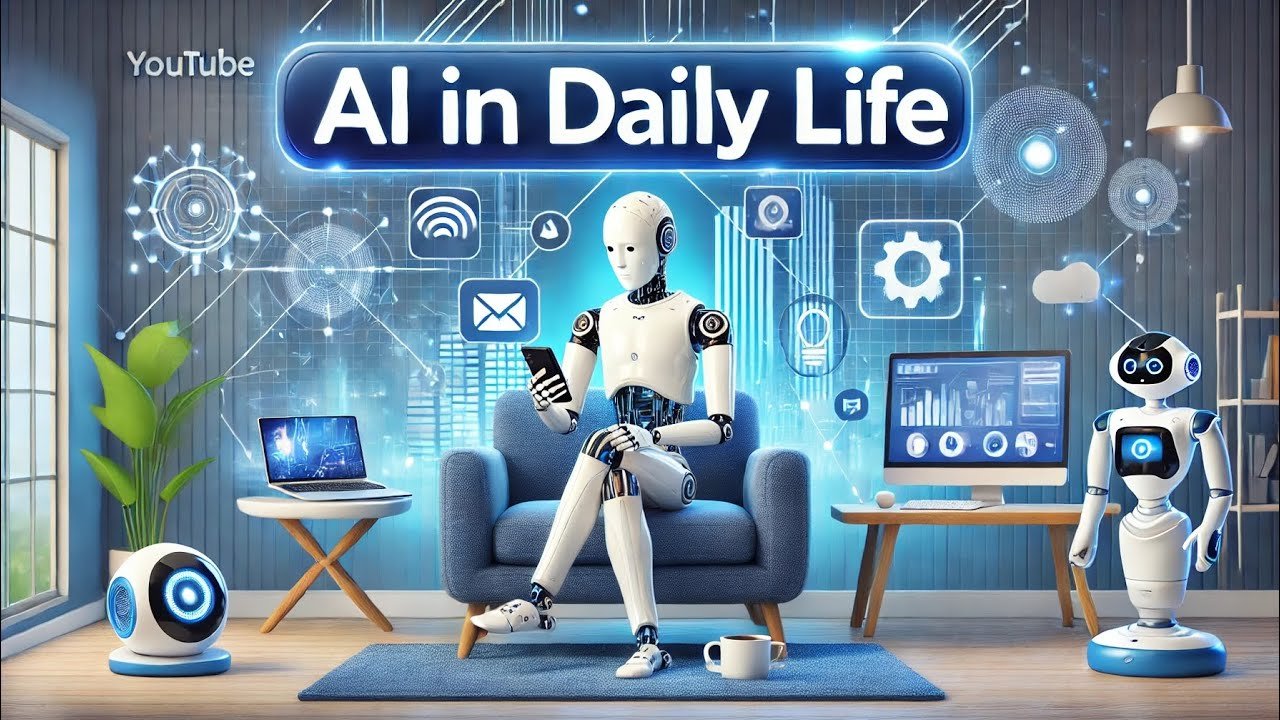
AI in everyday life is no longer a futuristic idea. It is already part of many things we do, often without us noticing it.
When you unlock your smartphone with your face, ask a voice assistant a question, receive a movie recommendation, check traffic on a navigation app, or shop online, artificial intelligence may be working quietly in the background.
For many people, AI has become less about robots and science fiction and more about ordinary technology that helps make daily activities faster and easier.
But how exactly does AI affect our lives? And where do we encounter it during a normal day?
Let’s look at 10 practical examples.
1. AI Makes Smartphones Smarter
Your smartphone is probably one of the easiest places to notice AI in everyday life.
Modern phones use artificial intelligence and machine-learning technology for many different features. Facial recognition can help unlock your device, while voice recognition allows you to interact with digital assistants.
Your camera may also use AI to recognize people, objects, lighting conditions, and different scenes. It can then automatically adjust the image to produce a better result.
Even predictive text, photo organization, noise reduction, and personalized recommendations can involve intelligent software.
The important part is that most of this happens automatically.
You don’t need to understand how the technology works to benefit from it.
Everyday example
Imagine taking a photograph at night. Instead of manually adjusting exposure, brightness, and other camera settings, your smartphone can automatically process the image and make improvements.
That small moment is a simple example of how artificial intelligence can make technology easier to use.
2. AI Helps Us Find Information Online
Searching for information has become one of the most common digital activities.
Search engines use sophisticated algorithms and AI technologies to understand what people are looking for and provide relevant information.
Instead of matching only the exact words typed into a search box, modern search systems can better understand the meaning and context of a query.
AI is also changing the way people interact with search engines. People can ask questions in natural language, explore topics, summarize information, and discover related ideas.
However, there is an important lesson here.
AI-generated information should not automatically be treated as fact.
AI systems can make mistakes, so important information should be checked against trustworthy sources.
For example, official government websites, universities, recognized organizations, and established publications can provide useful information for verification.
3. Social Media Uses AI to Personalize Your Feed
Open almost any social media application and you will see personalized content.
You don’t normally see every post published by every person you follow. Instead, algorithms help decide what appears in your feed.
These systems can analyze patterns such as:
- Posts you interact with
- Videos you watch
- Accounts you follow
- Topics you appear interested in
- Content you skip
- How long you spend viewing certain content
The purpose is to make the experience more relevant to each user.
This is another everyday example of artificial intelligence working behind the scenes.
Why does this matter?
Personalization can help people discover useful content, new creators, products, news, and entertainment.
At the same time, users should remember that algorithms influence what they see.
Being aware of this can encourage healthier and more thoughtful digital habits.
4. AI Changes How We Watch Movies and Listen to Music
Have you ever opened a streaming service and immediately found something you wanted to watch?
Recommendation systems make this possible.
Streaming platforms can analyze viewing or listening patterns and suggest content that may match your interests.
For example, if you regularly watch documentaries, the platform may recommend similar programs. If you listen to a particular type of music, you may receive playlists featuring similar artists.
This saves time because you don’t have to search through thousands of options yourself.
However, recommendations can also influence our choices.
The content we see is not always selected randomly. Algorithms can play a major role in deciding what appears in front of us.
5. AI Makes Navigation More Convenient
Navigation apps have changed the way people travel.
Instead of relying only on printed maps or asking for directions, people can use their phones to find routes within seconds.
Intelligent navigation systems can consider information such as traffic, road conditions, distance, estimated travel time, and changes happening along a route.
If traffic becomes heavy, the app may suggest another route.
For drivers, delivery workers, travelers, and businesses, this can save considerable time.
AI and travel planning
AI can also help people organize travel ideas, create itineraries, translate languages, and find activities.
However, information such as flight schedules, prices, opening hours, and travel requirements can change quickly. Always verify current details with the relevant official source before making important travel decisions.
6. AI Is Changing Online Shopping
Online shopping has become increasingly personalized.
When you visit an online store, you may notice product recommendations such as:
“You may also like”
or
“Recommended for you.”
These suggestions can be based on previous searches, products you viewed, purchases, and other interactions.
AI can also help businesses behind the scenes.
Companies may use intelligent systems to manage inventory, understand customer behavior, detect unusual transactions, answer customer questions, and predict demand.
For shoppers, this can create a more convenient experience.
But personalization also means that businesses may use data about how people interact with their services.
That makes privacy an important part of the conversation around AI.
7. AI Can Help Around the Home
The idea of a smart home has become much more realistic.
Today, people can use connected devices to control lights, security cameras, televisions, speakers, heating and cooling systems, and some household appliances.
Voice assistants can respond to commands and perform simple tasks.
Some smart cameras can detect movement and send notifications. Smart appliances may use sensors to adjust how they operate.
These technologies can make household routines more convenient.
Smart technology and privacy
The more connected a home becomes, the more important security becomes.
Before buying a smart device, it is worth checking:
- What information does the device collect?
- Where is that information stored?
- Can you control its privacy settings?
- Does the manufacturer provide security updates?
- Can you delete your data?
Convenience is useful, but it should not come at the expense of basic privacy and security.
8. AI Is Becoming a Helpful Tool at Work
The workplace is one of the fastest-changing areas of AI in everyday life.
Employees and businesses are using AI tools to help with tasks such as writing, summarizing, research, brainstorming, data organization, translation, customer support, and repetitive digital work.
For example, an employee might use AI to create a first draft of an email.
A business owner might use it to organize ideas for a marketing campaign.
A developer might use an AI assistant to understand or troubleshoot code.
A researcher might use AI to summarize a large amount of information before reviewing the original sources.
The technology can save time, but human review remains important.
AI-generated work may contain mistakes, misunderstandings, or information that needs further checking.
The most practical approach is to treat AI as an assistant rather than an unquestionable authority.
9. AI Is Changing the Way People Learn
Education is another area where artificial intelligence can provide useful support.
Students can use AI tools to:
- Explain difficult concepts
- Create practice questions
- Improve writing
- Translate information
- Generate study ideas
- Summarize notes
- Explore unfamiliar subjects
Teachers can also use AI to develop lesson ideas, create activities, organize information, and prepare educational material.
But there is an important distinction between using AI to learn and using AI instead of learning.
If a student asks AI to complete every assignment, they may get an answer without developing the knowledge or critical-thinking skills behind it.
AI works best as a learning partner.
Ask questions. Challenge the answer. Check sources. Try to solve problems yourself.
That approach can turn AI into a useful educational tool rather than a shortcut.
10. AI Can Make Small Daily Tasks Easier
Not every example of AI needs to be impressive.
Sometimes the most useful applications are simple.
An AI assistant can help you organize a list of tasks, draft a message, brainstorm dinner ideas, create a shopping list, summarize information, or explain something you don’t understand.
For example, imagine that you have five tasks to complete after work.
You could give the list to an AI assistant and ask it to organize the tasks based on urgency and estimated time.
You still make the final decision, but the AI helps you get organized.
This is where artificial intelligence can have a practical impact on ordinary life.
It doesn’t necessarily need to change everything.
Sometimes saving 15 minutes on a repetitive task is enough.
How AI Can Save Time in Everyday Life
One of the biggest reasons people are interested in AI is convenience.
A useful AI tool can help reduce the amount of time spent on repetitive digital tasks.
Depending on the technology, AI can help with:
Writing: Create drafts, improve grammar, or simplify complicated text.
Organization: Turn notes and lists into a more structured format.
Learning: Explain subjects using simpler language and examples.
Planning: Help create schedules, checklists, and basic plans.
Research: Help organize information and identify topics that need further investigation.
Creativity: Provide ideas for writing, design, video, presentations, and other projects.
The goal should not be to let AI do everything.
The goal is to use it where it genuinely helps.
Is AI Always Accurate?
No.
This is one of the most important things to understand about AI in everyday life.
AI systems can produce incorrect information. Sometimes they misunderstand a question. In other cases, they may generate an answer that sounds convincing but contains errors.
This is particularly important when using AI for:
- Medical information
- Financial decisions
- Legal questions
- Safety-related information
- Academic research
- Professional decisions
AI can help you understand a topic or find ideas, but important decisions should be based on reliable information and appropriate professional guidance.
A good habit is simple:
Use AI to assist your thinking, not replace it.
Privacy and AI
As AI becomes more common, privacy deserves more attention.
Many digital services collect information about how people use their products. Some AI systems may process conversations, searches, preferences, images, documents, or other information depending on the service.
Before using an AI application, take a moment to understand its privacy practices.
Avoid entering highly sensitive information unless you understand why it is needed and how the service handles it.
Good digital habits include using strong passwords, keeping software updated, reviewing privacy settings, and being careful about what information you share online.
Will AI Replace Humans?
The growth of AI has led many people to ask whether artificial intelligence will eventually replace human workers.
The answer is not simple.
AI can automate certain tasks, especially repetitive tasks that follow predictable patterns.
But human beings bring qualities such as personal experience, empathy, responsibility, judgment, creativity, and understanding of real-world situations.
In many workplaces, the future may involve people working alongside AI rather than simply being replaced by it.
Someone who knows how to use AI effectively may be able to complete certain tasks faster while still providing the human judgment that technology cannot fully replace.
What Does the Future of AI Look Like?
The role of artificial intelligence will likely continue to expand.
We may see more advanced personal assistants, smarter homes, AI-supported education, intelligent transportation, improved healthcare technology, robotics, and new forms of digital communication.
Some developments will make life easier.
Others will raise difficult questions about privacy, employment, creativity, security, and responsibility.
That is why understanding AI matters.
People don’t need to become programmers or engineers to participate in the AI conversation.
They simply need to understand what these technologies can do, where they can help, and where caution is necessary.
Final Thoughts
AI in everyday life is already here.
It can be found in our phones, search engines, social media feeds, entertainment services, navigation apps, online stores, workplaces, schools, and homes.
Some AI applications are obvious, while others operate quietly in the background.
The important thing is not to use AI simply because it is available.
Instead, we should ask a more useful question:
Does this technology actually make my life better?
When used thoughtfully, AI can save time, support learning, simplify repetitive work, and help people explore new ideas.
But humans should remain responsible for important decisions.
The future of AI isn’t simply about creating smarter machines.
It is about learning how humans and intelligent technology can work together in a useful, responsible, and practical way.
Frequently Asked Questions
What is AI in everyday life?
AI in everyday life refers to the use of artificial intelligence in ordinary activities such as smartphone features, online search, navigation, entertainment recommendations, shopping, education, work, and smart home technology.
What are common examples of AI?
Common examples include facial recognition, voice assistants, recommendation systems, navigation apps, spam filters, predictive text, translation tools, chatbots, smart cameras, and AI writing tools.
How does AI help people every day?
AI can help people save time, organize information, find recommendations, communicate, learn new subjects, complete repetitive tasks, and generate ideas.
Is AI safe to use?
AI can be useful, but it has limitations. Users should protect sensitive information, verify important answers, and understand how the services they use handle personal data.
Can AI replace humans?
AI can automate some tasks, but human judgment, responsibility, experience, creativity, and empathy remain important. In many situations, AI is more useful as a tool that supports people.
Why should people learn about AI?
AI is becoming part of everyday technology. Understanding it can help people make better decisions about technology, privacy, work, education, and digital life.