


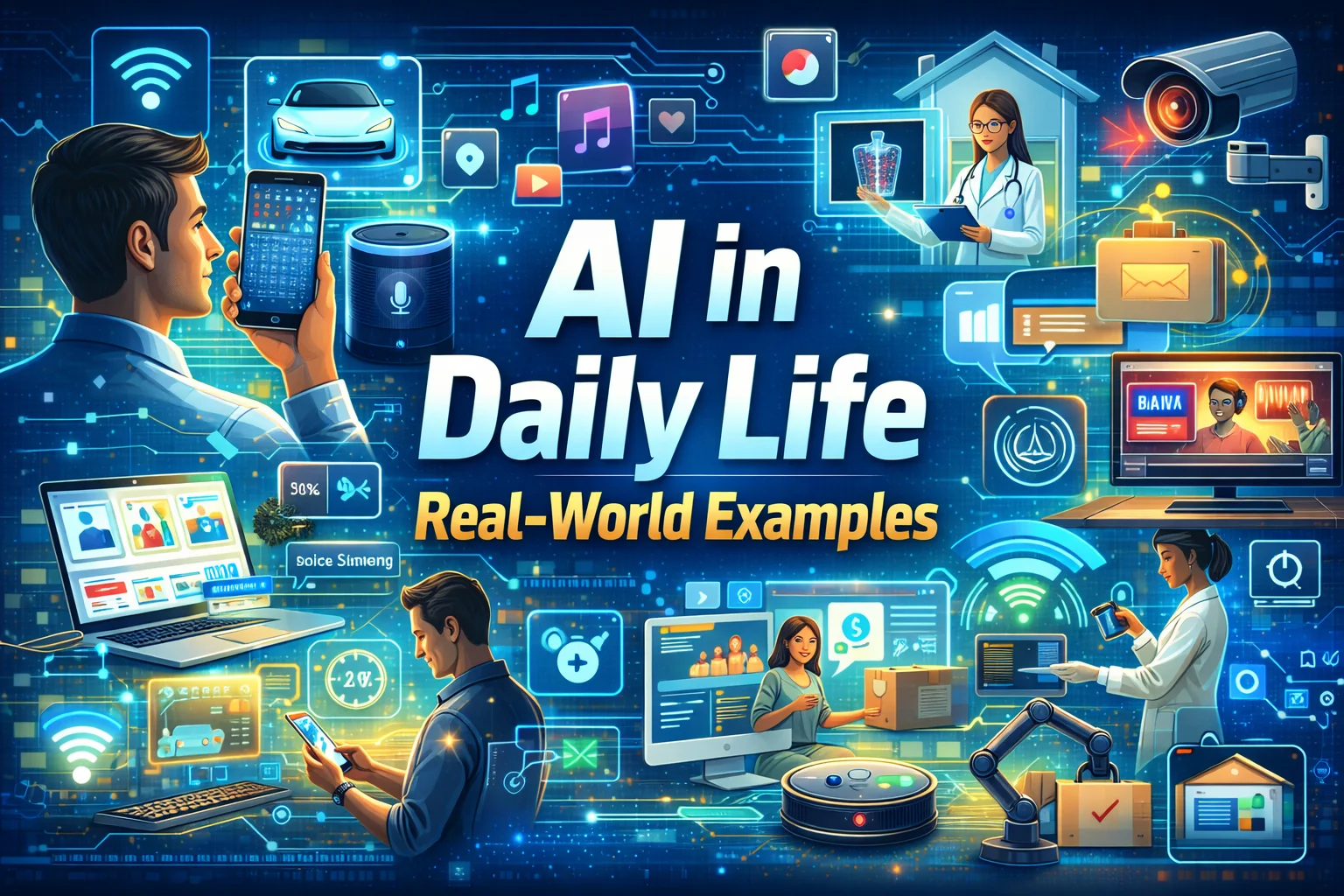
Artificial intelligence is no longer something people only hear about in technology news. It has quietly found its way into ordinary routines.
You may use AI when writing an email, checking a route, searching for an answer, comparing products, sorting photos, learning something new, or deciding what to watch. Most of the time, you probably do not stop to think about what is happening behind the screen.
The useful part is simple: AI makes everyday tasks easier by taking care of repetitive steps, organizing information, and helping people get useful results without doing everything manually.
That does not mean AI needs to handle an entire task from beginning to end. Sometimes the biggest benefit is much smaller. It might give you a starting point, turn messy notes into something organized, or save ten minutes on a job you normally repeat every day.
Here are 10 practical ways people are using AI in everyday situations.
1. AI Makes Everyday Tasks Easier When Writing Messages and Emails
Writing a simple email can occasionally take far too long.
You know what you want to say, but the wording does not come together. Maybe the message needs to sound professional. Maybe you are replying to a frustrated customer and want to avoid making the situation worse. Or perhaps you simply do not feel like spending ten minutes polishing three paragraphs.
An AI writing assistant can help create a first draft from a few points.
You might give it the main details and ask for a short, professional message. From there, you can edit the wording until it sounds like you.
It can be useful for:
- Professional emails
- Customer responses
- Short messages
- Meeting summaries
- Follow-up emails
- Grammar correction
- Rewriting and editing
The important thing is not to send the result automatically. Read it first. Add missing details. Change anything that does not sound natural.
The tool handles the starting point. You handle the final message.
2. AI Helps You Plan Your Day
A long task list does not always mean a productive day.
When appointments, deadlines, calls, personal errands, and unexpected problems start competing for attention, it becomes difficult to decide what should happen first.
AI can help sort that mess into something more manageable.
Give it your priorities, deadlines, meetings, and available time. It can suggest an order for the tasks or turn everything into a basic schedule.
For example, a freelancer might have three client deadlines, two calls, and several smaller jobs to finish. Rather than looking at the whole list and guessing where to start, they can use AI to organize the work into realistic blocks.
The schedule will not always be perfect. Real life rarely follows a perfect schedule. But having a sensible starting point can remove some of the mental clutter.
3. AI Makes Research Faster
Research can become frustrating when the subject is unfamiliar.
One article points to another. A technical term sends you searching for an explanation. Before long, you have a browser full of tabs and still are not sure which information actually matters.
AI can be useful during those early stages.
You can ask for a plain-language explanation, a summary of a complicated idea, a comparison between two concepts, or a list of questions worth investigating.
For example, someone researching solar panels for their home might first ask AI to explain the basic differences between panel types. That gives them enough background to understand the more detailed material they find afterward.
This is where AI makes everyday tasks easier without necessarily replacing the research itself.
For important subjects, though, the original sources still matter. AI can help you understand information, but facts should be checked against reliable sources before you rely on them.
4. AI Helps With Shopping Decisions
Online shopping can be surprisingly tiring.
There may be hundreds of products that appear to match what you want, followed by dozens of reviews and specifications that are difficult to compare side by side.
AI can help reduce the clutter.
Suppose you are looking for a laptop. Instead of simply asking for “the best laptop,” you can explain what you actually need: a particular budget, good battery life, enough storage, a certain screen size, and enough performance for the software you use.
You might compare products based on:
- Budget
- Performance
- Battery life
- Storage
- Screen size
- Intended use
AI can summarize the differences and help narrow the choices.
That saves time, but it should not replace your own checking. Prices change, specifications can be misunderstood, and an AI recommendation may leave out something that matters to you.
Use it to narrow the field. Then make the final decision yourself.
Navigation apps already do a lot more than display a map.
They can account for traffic, changing road conditions, estimated travel times, and alternative routes. When an accident causes a delay ahead, the recommended route may change within minutes.
That is one of those everyday examples where the technology is doing complicated work without asking the user to think about it.
AI can also be useful before the journey starts. It can help organize destinations, compare travel options, arrange a rough itinerary, or identify activities that fit within a limited amount of time.
Planning a trip can become much easier when you do not have to organize every little detail manually.
For more practical examples of AI in ordinary routines, you can also read AI in Everyday Life: 12 Powerful Ways It Helps Us.
6. AI Helps Manage Photos and Videos
Photo libraries have a habit of becoming enormous.
A few months of taking pictures can leave you with hundreds or thousands of files. Finding one particular image later is not always easy.
AI-powered photo tools can recognize people, objects, scenes, and locations. Some can group related images, improve image quality, remove unwanted elements, or help identify duplicate pictures.
The same idea extends to video.
Creators can use AI-assisted tools to generate captions, remove backgrounds, clean up audio, find useful sections of a recording, or turn long videos into shorter clips.
For a casual smartphone user, the benefit might be less time spent organizing a camera roll. For a content creator, it could mean getting through editing much faster.
7. AI Makes Learning More Convenient
Not everyone understands a topic from the first explanation.
Sometimes the textbook is too technical. Sometimes the tutorial assumes you already know something that you have never heard of. And sometimes you simply need the idea explained in a different way.
AI can help with that.
You can ask for a simpler explanation, a practical example, a step-by-step walkthrough, or a comparison with something familiar.
It can also create:
- Practice questions
- Study summaries
- Flashcards
- Explanations
- Examples
- Learning exercises
That makes self-study more flexible. You can adjust the explanation instead of searching for an entirely new resource every time you get stuck.
Still, learning requires active thinking. It is better to use AI to understand a difficult idea than to use it to avoid understanding the idea altogether.
8. AI Automates Repetitive Work
Some of the best uses of AI are also the least glamorous.
Think about the small jobs that repeat every day: sorting information, cleaning up documents, transcribing recordings, creating routine reports, or preparing similar responses.
None of these tasks are necessarily difficult. They are just time-consuming.
Depending on the workflow, AI can assist with:
- Sorting information
- Creating summaries
- Transcribing audio
- Generating reports
- Formatting content
- Categorizing data
- Creating routine responses
The advantage becomes obvious when the same job has to be done dozens or hundreds of times.
A task that takes six minutes may not seem like much. Repeat it ten times and you have already lost an hour.
This is another area where AI makes everyday tasks easier by taking some of the repetitive effort out of the process.
9. AI Helps With Content Creation
Creating content often looks easier from the outside than it really is.
A blog post may begin with an idea, but then someone has to create an outline, write the draft, find examples, edit the wording, prepare images, write captions, and make everything ready for publication.
AI can help with several of those steps.
For example, creators can use it for:
- Blog post ideas
- Social media captions
- Content outlines
- Image concepts
- Video scripts
- Headlines
- Product descriptions
The first result does not need to be perfect.
A writer might use an AI-generated outline as a starting point and then replace most of it with their own ideas. A designer could use generated concepts to explore directions before creating the final visual. A marketer might ask for several headline options and then choose one that fits the campaign.
For more on this side of AI, see AI and Creativity.
The human contribution still matters. Experience, taste, context, and originality are what turn a rough suggestion into something worth publishing.
10. AI Helps With Everyday Problem-Solving
Some problems do not have an obvious starting point.
You might be trying to organize a project, prepare for a meeting, troubleshoot a technical issue, or compare several possible approaches.
AI can be useful as a thinking partner.
Describe the situation. Explain what you are trying to achieve. Then ask for a few possible approaches or ask the system to break the problem into smaller pieces.
For example, you could use it to turn a rough project idea into a sequence of tasks. Someone preparing for a meeting might ask for questions they should consider. A person dealing with a technical problem could use AI to explain unfamiliar terminology before looking for a deeper solution.
The answer is not necessarily the important part.
Sometimes the real benefit is seeing the situation organized clearly enough to think about it properly.
Why AI Can Save So Much Time
The time savings from AI do not always come from one dramatic shortcut.
Usually, it is the small stuff.
A few minutes saved on an email. Another few minutes spent less on research. A repetitive report handled more quickly. Photos sorted without manually opening every folder.
Those minutes can add up.
Imagine saving five minutes on six routine tasks during a workday. That is half an hour. Over several weeks, the difference becomes much more noticeable.
This is why AI makes everyday tasks easier even when the technology is not doing anything spectacular. It is removing friction from activities people already need to complete.
AI Does Not Have to Do Everything
Once you start using AI, it can be tempting to give it every task.
That is not always useful.
Some things are quicker to do yourself. Others need human judgment. A sensitive customer conversation, an important business decision, or a personal situation may depend on context that a tool simply does not have.
People bring experience, emotions, relationships, intuition, and an understanding of the situation around a task.
So instead of asking how you can make AI do everything, ask a more practical question:
What part of this task is repetitive, time-consuming, or difficult to organize?
That is usually where the technology earns its place.
How to Use AI More Effectively
A vague request usually produces a vague result.
Compare these two prompts:
“Write something about marketing.”
and:
“Create a 500-word beginner-friendly explanation of digital marketing for a small business owner. Use simple language and include three practical examples.”
The second request gives the tool something useful to work with.
Tell it who the audience is. Explain the goal. Give it relevant context. Mention the format and length you need. If you dislike the first response, explain what needs to change.
That back-and-forth is often where the useful result appears.
It is also worth checking the information before you publish or act on it. AI can make factual mistakes, misunderstand instructions, or confidently present something that turns out to be wrong.
For general information about responsible and trustworthy AI practices, the National Institute of Standards and Technology provides useful resources.
The Future of Everyday AI
AI will probably become less noticeable, not more.
Instead of opening a dedicated AI application, people may interact with AI features inside tools they already use. Email, calendars, search engines, shopping platforms, education software, design programs, and communication apps can all provide assistance without feeling like entirely new products.
That shift could change what people expect from software.
Rather than learning every step manually, you may simply describe the result you want and let the software handle some of the groundwork.
The useful technology may be the technology you barely notice.
Final Thoughts
AI is already helping with tasks that used to take more time, patience, and manual effort.
It can help write an email, organize a day, research a topic, compare products, plan travel, sort photos, support learning, automate repetitive work, create content, and break complicated problems into manageable pieces.
The real advantage of AI makes everyday tasks easier is not that machines suddenly do everything for us.
It is that some of the tedious parts can be handled more quickly, leaving people with more time for decisions, creativity, communication, and work that actually requires human judgment.
Used sensibly, AI can be a genuinely useful everyday assistant. The trick is knowing where it helps, checking information when accuracy matters, and keeping control of the decisions that matter most.